This article is necessary because the phrase “Twelve or 14 moonshines” an extract from Edmund’s (Sol.1)“King Lear” is impossible to understand without specialist knowledge – although exceedingly important because encompassing the entire Shakespeare cannon (specifically regarding Elizabethan England) it divulges his greatest revelations.
In its entirety (this short but important line) follows exactly as it appears in the 1608 Quarto – as stipulated by ‘Shakespeare’ with the number “twelve” written in letters, and the number “14” in digits – the purpose of which is to attract our attention to it:
“For that I am some twelve or 14, mooneshines lag of a brother”. (Quarto spelling)
Proceeding step by step, I would like to explain how every segment of this line is autobiographical – thereby showing how our great author, poet and playwright saw himself in a Godly way, while instructing us about his highly unusual Royal nativity, who the brother in 1601 he had recently been “deprived” of was – and why the word “moonshines” relates emphatically to his mother and not a passage of time. Now, before continuing further, to make things more easily understandable there follows a synopsis of the individual segments of the sentence – broken down into five sections.
- “That I am” is a contraction of the biblical phrase “I AM THAT I AM”, an instruction of identification by God to MOSES before going amongst the Israelites in Egypt, an idiom our author was much taken with (also placing him amongst the Masonic order), while in terms of gematria it acts as a manicule identifying sonnet 91, where found in the first stanza are ‘7’ iterations of “William Shakespeare’s SOME acronym”.
- The word “S*O*M*E” he promoted as an autobiographical acronym (unable to elaborate upon it in his own lifetime).
- “Twelve or 14” are numbers relevant in respect of his highly unusual (and extraordinary) Royal nativity (relating to both his ‘official’ birthday and more importantly the actual day he was born – his creation).
- The word “Moonshines” relates to his mother.
- The word “Lag” informs gematrically, precisely who our author’s deceased brother was – while uniting him mathematically with Jesus Christ in a construction known as “The Essex/Christ Allusion” which was founded on the number ‘XIX’.
“The Curiosity of Nations”
Edmund’s (Sol.1) is a soliloquy (in fact a solson) deliberately constructed of ’14’ lines ‘Q’ unambiguously informing us by “plague of custom” and “curiosity of nations” that he had been deprived of a brother!
Thou, Nature, art my Goddess; to thy law my services are bound. Wherefore should I stand in the plague of custom, and permit the curiosity of nations to ‘deprive’ me? For that I am some twelve or 14, moonshines lag of a brother? Why bastard? Wherefore base?
Our Great Author thought himself very Godly. The phrase “I AM THAT I AM” appears in line ‘IX’ of (S.121) a sonnet in which he seeks mitigation for incestuous behaviour by illuminating his Godliness, as the Roman numerals ‘IX’ alternatively seen as (iota & chi) are Jesus Christs initials in Greek, his name in Greek: Ιησούς Χριστός
Informatively the confessional (S.121) is a ‘one to one’ with God, beginning by telling us that in rebuffing his mother’s “vile” desires he would be reproached (admonished) by her:
‘Tis better to be ‘vile’ than vile esteemed,
When not to be, receives reproach of being.
While this persistent omnipresent Tudor behaviour forms the unsavoury underworld we find lurking even in the ancient times of Lear:
The art of our necessities is strange
And can make ‘vile’ things precious.
“Vile” and “evil” are anagrams of one another, while there is a consensus of opinion these days that such adjectives perfectly define the act of incest. None of this should come as a shock – as it is well known the Tudor dynasty was engulphed by the spectre of incest and the principal reason our yoke with Rome got broke. “William Shakespeare’s – Sonnet 67” was specifically selected by him to describe the painting of ‘Henry VVriothesley 3rd Earl of Southampton and his cat ‘TRIXIE’ imprisoned in the Tower of London’, because VVriothesley was ‘incestuously’ sired by our great author. Employing simple gematria (in conjunction with the Elizabethan alphabet) confirmation of this is found because the word I*N*C*E*S*T converts to ‘67’. This sonnet is subversive because part of its purpose was to commemorate the life of ‘Robert Devereux 2nd Earl of Essex’ who together with VVriothesley on February ‘XIX’ 1601 where convicted of high-treason – while one week later it was only ‘Essex’ executed. Henry VVriothesley was saved from the scaffold by his father (court poet) who prostrated himself before the Queen – pleading for his son’s life, (S.145) recalls this moment of history:
But when she saw my woeful state Straight in her heart did mercy come.
In this sonnet ‘Sacred 3’ pokes its head above the parapet in negative form – our author having the ability to see all words mathematically supplies three renditions of the words “I hate” two words which individually equate gematrically to two out of the three most Christian numbers: ‘IX’ & ’33’, and in so doing cleverly allude to ‘the passion’ of Christ (‘IX’) suffered aged ’33’.
Testimony to this truth is gathered by the third most Christian number ‘XIX’ as there are ‘XIX’ words beginning with the letter ‘S’ for Southampton configured in (S.67) a device part of a more elaborate mechanism explained at the end of this article known as: “The Essex/Christ Allusion”.
The intellect & sovereignty of mind possessed by our great author – as said, were attributes availing him ability to see words numerically, and as just illustrated he saw all letters gematrically (each with a numerical value) an obvious example being the word “bad” which in later life he associated with his mother (the mortal moon).
Of considerable significance is the fact Queen Elizabeth’s passing in 1603 is described in line ‘5’ of (S.107) – critically ‘E’ for Elizabeth being letter ‘5’ of the alphabet – with ‘7’ denoting her day-of-creation, numbers ubiquitous across the Shakespearean cannon alluding to the Queen, numbers effectively used as a code in the following line identifying her passing.
The mortal moon hath her eclipse endured. (S.107 – L 5)
Written during the inaugural year of ‘King James’ reign, very shortly after Elizabeth’s death in (S.114 – L.7) the words “every bad” allude to Henry VVriothesley’s Royal parents – his father represented by the word “every” and his mother by the word “bad”, a reality partially confirmed by “Two Loves Suggest Me” (S.144) a whimsical sonnet referring to mother and son as “Two angels”, which amusingly concludes intimating ordnance – when Queen Elizabeth (presumably at Windsor) with a single salvo expunges the Godly Henry VVriothesley from the confines of her company:
Yet, this shall I ne’er know but live in doubt,
Till my bad angel fire my good ‘One’ out.
In terms of simple gematria A = 1, B = 2, C = 3 & D = 4 etc – therefore (with no lack of irony) the word “bad” equates to the Godly number ‘7’, significant as Elizabeth was born 7th September 1533, while as already said ‘E’ for Elizabeth is letter ‘5’ of the alphabet, numbers therefore presenting the sum 7 + 5 = “twelve”, the figure representing our author’s ‘official’ birthday. Having said that, he wasn’t at all fond of this date (or the word ‘birthday’) as they always arrived unwelcome reminders of his illegitimacy, as in his Godly mind he considered Princes should never be associated with ‘birthdays’, believing (like Gods) they were divinely ordained in Heaven, while on Earth ‘created’ incarnate – a point addressed by ‘Sir Lawrence Olivier’ when summarising Shakespeare in the following vaulted fashion:
The nearest thing in incarnation to the eye of God.
The first English-language writing manual by Jehan de Beau-Chesne and John Baildon wasn’t published until 1570, officially it had only 23 letters, excluding the three modern day letters ‘J’, ‘U’ & ‘W’. The following is a transcription of this gematrical code formed in conjunction with the Elizabethan alphabet – which is fundamentally the same as the classical Latin alphabet.
A = 1, B = 2, C = 3, D = 4, E = 5, F = 6, G = 7, H = 8, I = 9, K = 10, L = 11, M = 12, N = 13, O = 14, P = 15, Q = 16, R = 17, S = 18, T = 19, V = 20, X = 21, Y = 22, Z = 23.
A pertinent illustration of how close our author’s heart was to gematria is seen in the word “Rose” frequently used by him alluding to his Royal son (The Faire Youth) Henry VVriothesley 3rd Earl of Southampton – the ‘very first word’ selected by him in his sonnet-sequence both capitalised and italicised (arriving only in the second line), which converts gematrically the following way:
R = 17, O = 14, S = 18, E = 5 the sum ‘54’.
It is no coincidence (S.54) is a sonnet about a Rose (but not just any old Rose) our author’s favourite Rose ‘Henry Wriothesley’, as we see how intriguingly it translates: ‘17’ equals our author’s Earldom, ‘14’ his TRUE date-of-creation, while he always associates ‘18’ synonymously with Southampton and ‘5’ with Elizabeth – I must also mention his most beloved (S.18) with its celebrated beginning:
Shall I compare thee to a summer’s day.
(S.18) is a sonnet about Southampton – our author finding equanimity between the letter ‘S’ and ‘18’, while also uniting the bonding letters ‘S’ for Southampton and ‘O’ for Oxford, forming the adverb “So”, which I somewhat prematurely mention because they are the first two letters in “William Shakespeare’s SOME acronym”, but “So” is not so-so, for in beginning the sonnet’s concluding rhyming-couplet eternal truths are revealed regarding the incestuous hierarchy of the Tudors, truths – that even given the oxygen of time – eyes still fail to see.
So long as men can breath and eyes can see,
So long lives this and this gives life to thee.
Then, regarding the longest poem – number ‘18’ in P.P (The Passionate Pilgrim) we again find Oxford linking Henry VVriothesley 3rd Earl of Southampton with ‘18’, but also with “Rose” because he is ‘Tudor’, and because we find (P.P) poem number ‘18’ deliberately composed of ‘54’ lines – for in terms of gematria – as already seen “Rose” translates to ‘54’ as: R = 17, O = 14, S = 18, E = 5.
This loving affiliation our author had with gematria we see expanded further as the second word found both capitalised and italicised in the “procreation sonnets” (the first 17 sonnets) is “Audit“, found in line ‘twelve’ sonnet ‘4’ which translates gematrically to ’53’.
A = 1, U = 20, D = 4, I = 9, T = 19 totalling ‘53’.
Having already seen sonnet 54 describe the “Faire Youth” as a ‘Tudor Rose’ we must now understand him more ethereally as a ‘God’ as herein our great poet and playwright refers to him five times as ‘One’ a Hebrew or Hermetic term for God. Interestingly, combining sonnets 53 & 54 together we arrive at the sonnet announcing Queen Elizabeth’s death (S.107): “The mortal moon hath her eclipse endured” where importantly we see this sad news arriving in line ‘5’.
“I AM THAT I AM”
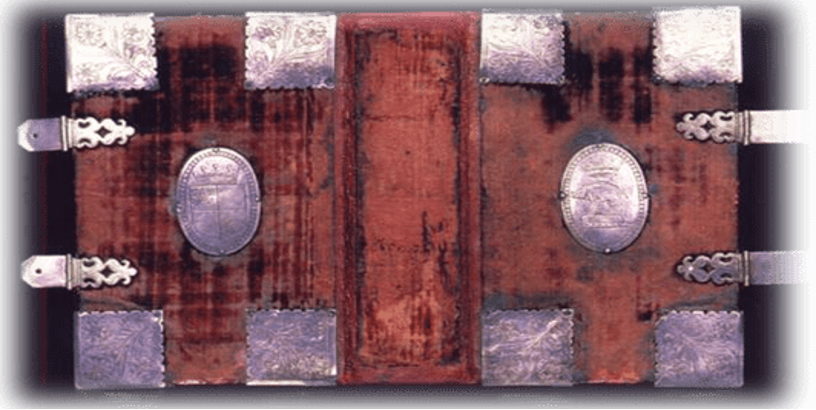
After a busy life Edward de Vere’s Geneva Bible (illustrated below) can be found resting in the ‘Folger Shakespearean Library’ Washington D.C.
Looking inside – the following facsimile is what ‘Exodus’ Chapter 3: Verse ’14’ says, while remembering Oxford’s TRUE date-of-creation was July ‘14’ 1548.
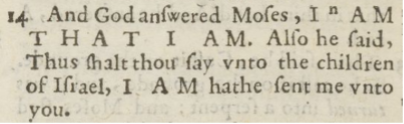
Oxford perceived Moses as a messenger of God sent into Egypt to free the Israelites, seeing himself in the same light (as a messenger) wishing to convey the truth, mindful of the gematrical fact “I AM THAT I AM” equated to ‘91’, thereby dispersing to humanity the ‘7’ Godly renditions of “William Shakespeare’s SOME acronym” found in the first stanza of (S.91) a revelation we shall shortly be coming to look at closely.
Mund being the German word for ‘mouth’ – makes ‘Edmund’ a mouthpiece for Edward – who has three ‘autobiographical’ soliloquys in the first Act of Lear, the ‘second’ of these telling us precisely who his TRUE parents were, while as just alluded to, he adored the biblical phrase: “I AM THAT I AM” which appears in (Sol.2) in bipartite form, mirroring the way God used the idiom found in Exodus chapter ‘3’ verse ‘14’.
My father compounded with my mother under the dragon’s tale and my nativity was under Ursa Major, so that it follows I AM rough and lecherous. Fut! I should have been THAT I AM had the maidenliest star in the firmament twinkled on my bastardising.
“The maidenliest star in the firmament” is Virgo (the Virgin) ironically Elizabeth’s star-sign – when in reality her red hair and hot-blood saw ‘Shakespeare’ in his first officially published poem of 1593 allegorise her as “Venus”. Unfortunately for Oxford the Queen decided against the path of legitimisation for him – which would of course have had the inevitably (and unthinkable) effect of turning her ‘virginal’ self into a laughing-stock, and worse.
He uses the somewhat negative term “compounded” for his father ‘Sir Thomas Seymour’ (suggesting an absence of love) but the only person he could have received details from (regarding his own conception) was Elizabeth (as his father was executed when he was eight months old) while the question we must consider – is just how realistic would his mother’s testimony have been?
‘Kallos’ the Greek word for “Beauty” is the English word ‘Shakespeare’ principally favours when alluding to Elizabeth – it appears in this sense in only the second line of the sonnets, his second favourite allusion for her is the word “Nature”.
“From fairest creatures we desire increase,
That thereby ‘beauties’ Rose might never die”.
Meaning; ‘Royal children’ (in particular Henry VVriothesley) our author’s “tender heire” should procreate, to facilitate Elizabeth’s Tudor-Rose dynasty continuing ad infinitum. ‘Kallos’ is also the origin of the name ‘Callisto’ and the reasons he mentions the constellation ‘Ursa Major’, as mythology informs us this star cluster was formed when ‘Zeus’ to protect ‘Callisto’ & ‘Arcas’ from his vengeful wife ‘Hera’ threw them into the night sky forming the constellation ‘Ursa Major’ (‘Hera’ having turned ‘Callisto’ into a bear).
‘Ursa Major’ was one of the original ‘48’ constellations identified by ‘Ptolemy’ in his astronomical work ‘Almagest’, so here Oxford cleverly alludes to his TRUE year-of-creation 1548. In using the words “under the dragons tale” he references his mother (the mortal moon) because astronomically speaking “the dragon’s tale” is the descending luna node, “so it follows” he is “rough and lecherous” as he was created under ‘Ursa Major’ (the Great Bear).
Already mentioned is ‘Sacred 3′ a system our author uses to stress things of great importance to him – where he simply provides three multiples of whatever he wishes to bring to our attention.
Edmund’s three soliloquys beginning Lear apart, other obvious examples are the fact he only ever drafted three dedications (all to Henry VVriothesley) “Venus & Adonis”, “Lucrece” and the “Sonnets”. In his “Phoenix” poem he alludes to his important Godly son VVriothesley using the word ‘One’ three times, in lines 26, 40, & 46. Then, having already mentioned “I AM THAT I AM” appearing in (Sol.2) and also in (S.121) inevitably a third rendition must also be found – which surfaces in post script in a letter written by Oxford to Sir William Cecil (found in the Cecil archives) dated 30th October 1584:
My Lord, I mean not to be your ward nor your child – I serve her Majesty and
‘I AM THAT I AM’.
As said, Gematrically speaking “I AM THAT I AM” equates to ‘91’, numbers our author saw individually as ‘IX’ & ‘One’, the Godly-number ‘IX’ the number he most liked to associate himself with, ‘One’ the Godly-number he associated with his son. Then recalling July ‘14’ as Oxford’s TRUE date-of-creation, remarkably we find the biblical definition of the Hebrew word for God ‘One’ arriving in Edward de Vere’s Geneva Bible in Zechariah chapter ‘14’ Verse ‘IX’.
And the Lord shall be King over all the Earth
In that day there will be one Lord and his name is ‘One’.
‘G’ for God is letter ‘seven’ of the alphabet, while bearing in mind Oxford’s mother Elizabeth was born 7th September 1533, and while we have seen Oxfordian-numerology Royally deliver us the number ‘91’, acting further as a manicule it identifies (S.91), thereby neatly bringing into focus the fifth word in the sentence we are most concerned with exploring – “William Shakespeare’s SOME acronym” of which we immediately observe ‘7’ iterations.
S*O*M*E
Some glory in their birth, some in their skill,
Some in their wealth, some in their body’s force,
Some in their garments, though new-fangled-ill,
Some in their Hawks and Hounds, some in their Horse.
And every humour hath his adjunct pleasure,
Wherein it finds a joy above the rest,
But these particulars are not my measure,
All these I better in ‘One’ generally best,
Thy love is better than high-birth to me,
Richer than wealth, prouder than garments’ cost,
Of more delight than Hawks or Horses be:
And having thee, of all men’s pride I boast –
Wretched in this alone, that thou mayst take
All this away and me most wretched make.
For many reasons at this juncture, we find ourselves in a kind of seventh-heaven for as already pointed out – the first stanza of (S.91) surrenders a Godly ‘7’ renditions of William Shakespeare’s “SOME” acronym. Incest apart – the sonnet provides elaborate biography representing an aristocratic class who “glory in their birth” show “their skill” (at the joust) wear garments “new-fangled ill” (from Italy) and generally fart around with sporting-pursuits restricted to the hoi-polloi involving “Hawkes & Hounds & Horses” particulars ultimately superseded by more human sensibilities referenced in lines 8 and ‘IX’.
All these I better in ‘One’ general best,
Thy love is better than ‘high-birth’ to me.
‘One’, alludes to our author’s Godly son, showing VVriothesley’s love even more esteemed than Oxford’s “high birth”, a lesson to us all true wealth should not be materially measured, but by things of greater worth.
The ‘7’ renditions of the acronym “S*O*M*E” are part of a deliberate and carefully considered strategy by our great and Godly author, that with ‘E’ for Elizabeth (representing the number ‘5’) provide numbers for a preliminary but necessary sum: 7 + 5 = “twelve”, a precedent for a more consequential sum: “twelve” + 14 = 26, numbers that represent our author’s extraordinary Royal Nativity (which we shall be coming to look at in greater detail) while in terms of gematria the word “S*O*M*E” equates the following way:
S = 18, O = 14, M = 12, E = 5 numbers totalling ‘49’ or as Oxford preferentially saw them (‘40’ & ‘IX’) while more importantly this Princely acronym has the following incestuous and hitherto unacceptable meaning:
Southampton & Oxford’s Mother was Elizabeth.
It is of considerable significance to understand the word “S*O*M*E” relates emphatically to the numbers “twelve or 14”, because ‘M’ is “twelve” and ‘O’ is ‘14’ which is precisely what our author says, “some twelve or 14 moonshines”, because the acronym “S*O*M*E” is determined by Oxford’s Royal nativity – i.e. in the fact he was Elizabeth’s son – as was VVriothesley.
Then, if we momentarily consider lines 3 & 4 of the “Emerald Tablet” (Tabula Smaragdina) believe engraved long, long ago, by the hand of ‘Hermes Trismegistus’ somewhat curiously we find a reflection of “The Tudor Trinity” (VVriothesley, Oxford & Elizabeth).
(3) … As all things were from one.
(4) … Its father is the sun its mother the moon.
To cut a long story short, whether true or false, every aspect of Elizabeth’s life was termed incestuous, as to a certain degree was her sister Mary’s.
Elizabeth’s early childhood got off to the worst start because as a three year old in the year 1536 her mother Anne Boleyn was executed, this in the same year she was declared a bastard by an Act of Parliament.
Oxford who had too much faith in the influence of literature during his own lifetime, squirrelled himself away – using the pseudonym “Ro Chester” and wrote “Love’s Martyr”, a work unsuccessful in persuading the literate to accept ‘foul as faire’, illegal as legal, or the illegitimate as legitimate, his literary efforts not having the intended effect of propelling his Godly son onto the throne of England. More blandly, what prevailed was the indelible fact history is written by the winners – who are not exclusively Royal:
Death is now the Phoenix nest …
Leaving no posterity
Twas not their infirmity
It was married-chastity.
“Married-chastity” would prevail – the myth of Elizabeth as virgin Queen still prevails even today – with “rare” VVriothesley still side-lined, and Oxford’s beautiful poem “The burning” found – still straining in the slips.
Suppose here burns this wonder of a breath,
In righteous flames, and holy-heated fires:
(Like music which doth rapt itself to death,
Sweet’ning the inward room of man’s desires).
So she wafts both her wings in piteous strife;
“The flame that eats her, feeds the others life:
Her rare-dead ashes, fill a rare-live urn:
‘One’ Phoenix borne, another Phoenix burne.
However educated, however vaulted VVriothesley’s DNA, however Godly he appeared in Oxford’s eyes, the fact he was born issue of a first degree incestuous union made him illegitimate – and that in the eyes of the law was what counted. This was the unsolvable dilemma rankling at the centre of his life and partially why he felt a need to write such compensatory adulation as found both in the Godly (S.33) and his ‘avian metaphysical poem’. His Royal eyes saw his “rare” son “first heire” to the crown of England – while at the sight of this angelic wonder, feeling a rush of blood, courtly privileged nobility knowingly tapped their noses – feeling sublimity in the company of this beautiful androgenous Prince:
A man in hew all Hews in his controlling
Which steals men’s eyes and woman’s souls amazeth. (Lines ‘IX’ & 10 – S.20)
Conversely, plebs obviously distanced from his serene princely presence (needing no instruction from parliament) easily found a “base” word to describe him. Then, transcending to the ethereal, aware from pre-history there exists something known as “The Numerical Cannon of Proportion”, we find ourselves still dwelling on “William Shakespeare’s SOME acronym” thereby harmoniously arriving at the symbolic sound of the universe “Om” found in the word’s belly. This tripartite mantra is traditionally believed composed of the letters “A – U – M”, which maybe an echo of a cosmic-hum possibly born from gravitational waves – a sound gematrically constructed of ‘One’ + twenty + twelve – as: A = 1, U = 20 & M = 12, delivering us the Christian number ‘33’. Patently, Oxford recognised the divinity of this number – the very reason he announced the paternity of his Godly son ‘Henry VVriothesley’ in line ‘IX’ (S.33).
Elizabeth’s Reign as Gloriana the Virgin Queen depended on the state and the courtier-class keeping schtum about her licentious and incestuous nature (a life path choice chosen from childhood) since aged eleven when the precocious princess translated a work arriving in England from the French-court via her mother ‘Anne Boleyn’ who received it (some say the original manuscript) from the hands of its author the Queen of Navarre ‘Marguerite d’Angoulême’.
“Le Miroir de l’âme pécheresse” was written by ‘Marguerite d’Angoulême’ Queen of Navarre – sister of ‘King Francis’ a religious meditation first published in 1531, a poem styled by Elizabeth (The Glass) or “Mirror of the Sinful Soul” its central trope the slightly dangerous subject of “Holy Incest” and with almost uncanny timing her English translation was finally published in “April” of the year of the 17th Earl of Oxford – Edward de Vere’s birth ‘1548’, poignantly ‘17’ years after Marguerite’s original French publication on the continent.
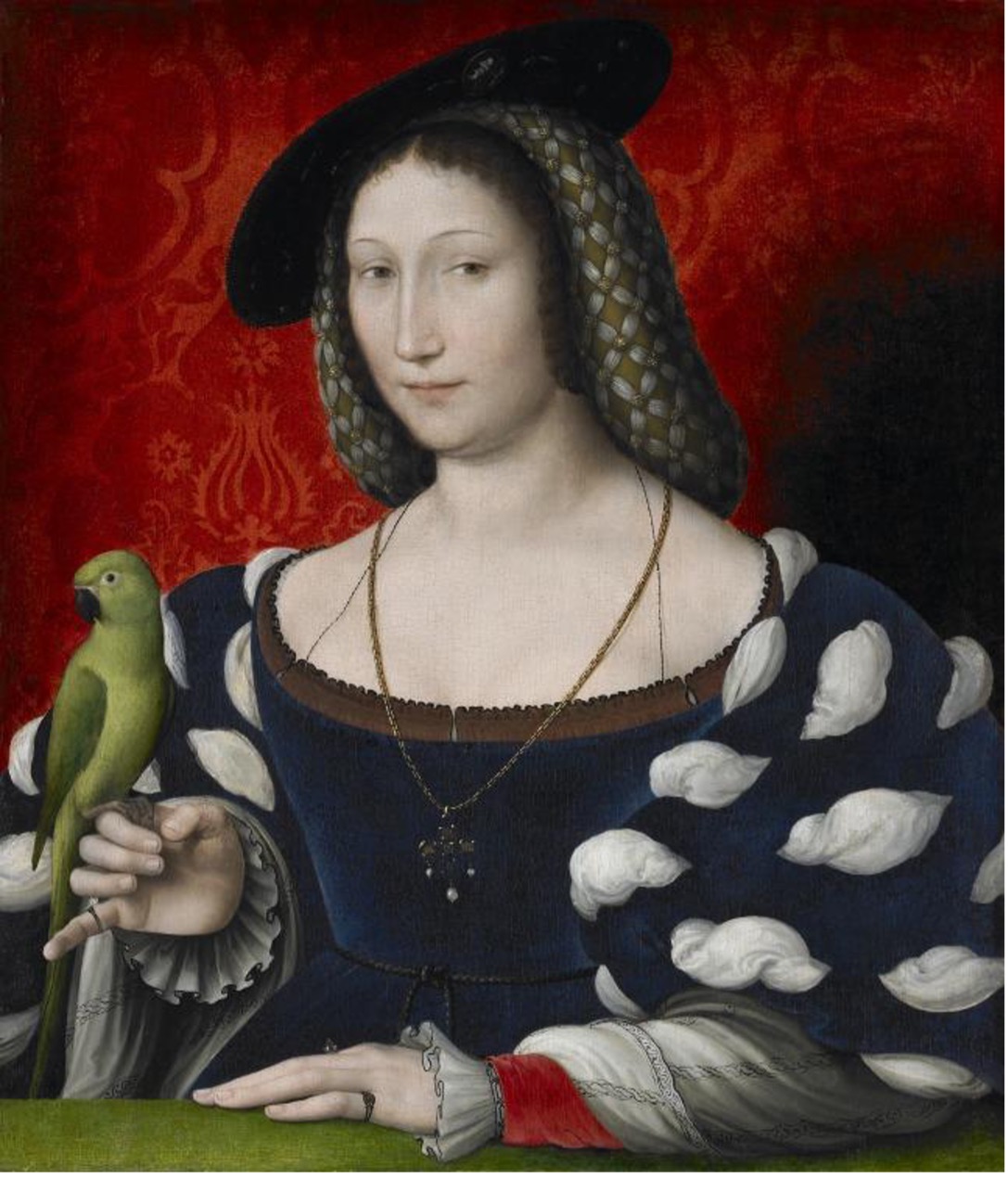
Marguerite d’Angoulême — Queen of Navarre sister of King Francis 1st of France the portrait attributed to Jean Clouet 1527.
In (S.3) our author subscribes to a doubly incestuous allusion, recalling the fact the interbred ‘VVriothesley’ (whom he fathered) was the spit ‘n’ image of his own mother Elizabeth (a likeness found as ‘illustrated’ are both princes as teenagers). The first allusion (regarding this visual duplication) unsurprisingly begins in line ‘IX’, but the more interesting, yet more obscure allusion from the following line, relates to a period of time: “the lovely April of her prime” with the word “prime” cleverly referencing both a ‘prime publication’ and ‘prime pregnancy’, as on July ‘14’ 1548 Oxford became the first of five illegitimate princes born to Elizabeth – intriguingly when she was only a ‘14’ year old princess, while ultimately this ‘first son’ incestuously fathered her last son ‘VVriothesley’ who arrived on this mortal coil ‘26’ years later.
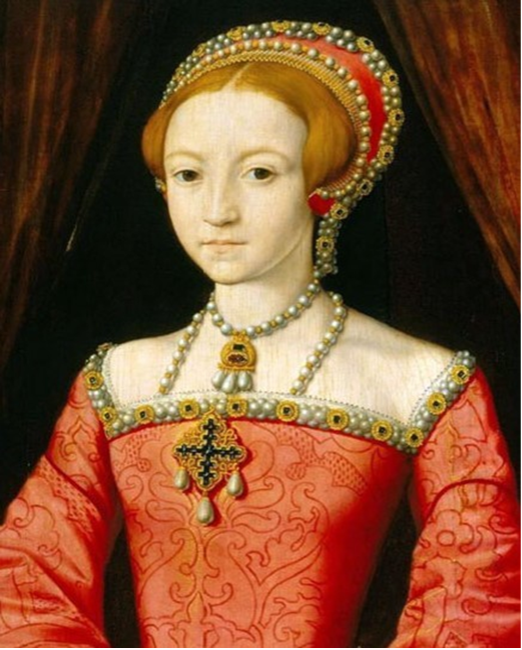
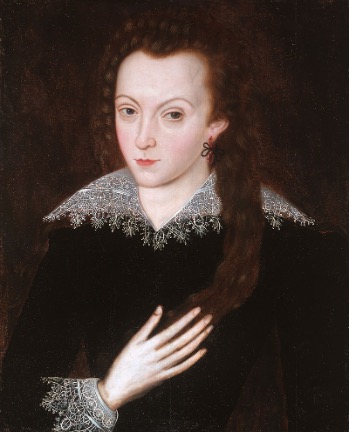
Thou art thy mother’s glass, and she in thee
Calls back the lovely April of her prime. (S.3)
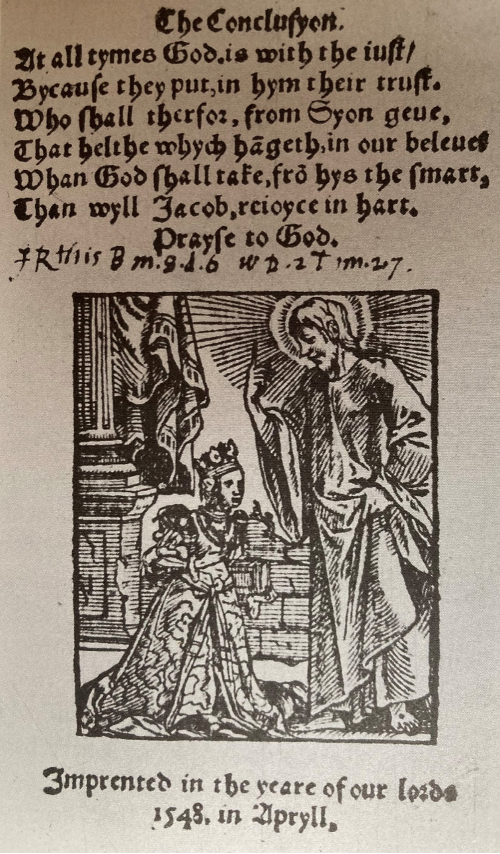
“Imprinted in the year of our Lord 1548 in Apryll.”
In the woodcut above Elizabeth is seen offering her retitled book to Christ as her friend and tutor ‘John Bale’ prudently suggested the following title would reflect the labours of her ‘prime-publication’ more sympathetically:
“A Godly Medytacyon of the Christian Soule”.
In April 1548 when ‘Elizabeth’s translation’ was first published by the Marburg publisher ‘Dirik van Straten’ her grace the princess Elizabeth found herself three months pregnant with ‘Lord Admiral Sir Thomas Seymour’s’ child, although unaware of the ‘miraculous’ fact – she was already halfway through what turned out to be only a six-month pregnancy! This fact of Oxford’s premature birth we find confirmed on the ‘first page’ of Lear by “Gloucester” (effectively his father) as his stately pile was Sudeley Castle, Gloucestershire.
This knave came something ‘saucily’ to the world before he was sent for, Yet was his mother faire, there was good sport at his making.
Alliteratively speaking our 17th Earl’s father was ‘Saucy-Seymour’ something we know because Oxford soliloquises the details of his ‘divine conception’ in Edmund’s (Sol.2) Lear, making no bones about his exalted DNA as we see him conceived by “divine-thrusting-on” (17 letters) words ‘immediately’ succeeded by the following:
An admirable evasion of whoremaster man to lay his goatish disposition on the charge of a star.
“Admiral” is a marsupial of the word “admirable” Hooray! We are no longer all at sea – because the TRUTH is spelled out to us – Oxford’s father (the divine thruster) was an “Admiral”.
Now, you will have heard the expression ‘What goes around cums around’, bringing us to the rather sticky question of vengeance. In mid-January 1548 our indefatigable, intellectual, precocious grace the ‘14’ year old princess Elizabeth had been deflowered, but these seeds of maiden destruction would eventually build a mighty forest of retribution – as she was empowered by the strength of a mother’s love, a strength that would almost never leave her, from a mother who would never called her “bastard”, who in the name of love posthumously bequeathed to her the incestuous and libertine culture of the French court. It is my supposition – around the time of Oxford’s arranged marriage to ‘Anne Cecil’ when he was a 23 year old, his mother (then 38) became a little jealous, and decided to claim what she considered rightfully hers – after all Oxford was her Prince and Royal son – his betrothed a mere commoner!
So very, very small, they cannot be seen at all (with the human eye) – these tiny little tadpoles of “liquid-pearl” can apparently even be released by the hand of a virgin Queen, before withered viticulture holds centre stage (Oxford always ahead of his time) amusingly describing in one of his most expansive poems his spent Royal-tackle as “senseless grapes”, little wonder such Familia action saw his cheeks “waxing red with shame!”
This unforgettable first act of incest is further reference by Lysander in MSND.
Tomorrow night, when ‘Phoebe’ doth behold
Her sil-ver visage in the wat’ry glass
Decking with ‘liquid pearl’ the bladed grass
(A time that lovers’ flights doth still conceal).
‘Documentary-evidence’ in the semblance of a confession exists regarding this first act of incest found recorded in the first stanza, of the very first poem, beginning the works of the “Poetical Essayists” in “Love’s Martyr”, works amounting to ‘17’ poems strewn over ‘14’ pages – concluding a work ‘written by Oxford’ using the witty pen-name “Robert Chester”. Of great significance, the dedication to ‘Sir John Salisbury’ signed “Ro. Chester” is in fact allusion to the city of ‘Rochester’ in Kent – where nearby what became Oxford’s very favourite (real-life) story took place – when his men robbed his father-in-law (William Cecil’s) men, at the foot of Gads Hill on 21st May 1573. One particular re-enactment of this robbery occurs in “Henry IV pt. 1” a scene including that great mountain of lard “Falstaff”, pilfering further alluded to immediately following Edmund’s (Sol.1 ‘Q’) Lear, when Edmund/Edward’s father “Gloucester” in describing Kent’s banishment obliges us with the following:
All this done upon the gadde.
Gematrically speaking “gadde” as spelt in ‘Q’ translates the following way:
G = 7, A = 1, D = 4, D = 4, E = 5 numbers totalling ‘21’.
Obviously here our great author (a gadfly) seeks to provoke orthodoxy by commemorating the original date of the ‘Gads Hill’ robbery “21st May 1573”.
Found in “Love’s Martyr” Oxford a stickler for tradition invokes ‘Apollo and the Muses’ in the very first of ‘14’ poems entitled “Diverse Poetical essays”.
INVOCATIO, ad Apollinem & Pierides.
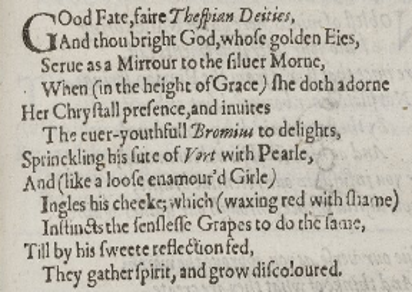
Image by kind permission ‘Folger Shakespeare Library’.
Of considerable significance line three of Oxford’s “INVOCATIO” reveals a perceptible similarity to “Mirror of the Sinful Soul” with the words “Mirror to the silver Morne”, the metre precisely the same – there being secret unity in the words “sinful” & “silver” as ‘lis/ver’ is an alternative way of visualising the word “silver” (the light of the moon) while you couldn’t possibly say “in the height of Grace” (L 4) or “Chrystall presence” (L 5) are not allusions to Queen Elizabeth – because they are.
For those of you interested in phonetics the word “Vərt” (L 7) provides us with the very first use in English text (1601) of the schwa /e/, found expressed in the word “Vərt” by an upside-down lower-case “ə”.
The schwa-sound is by far the most common sound heard in the English language and the fact the schwa /e/ originated in the Hebrew language shows Oxford had studied Hebrew. Also significant is the fact we find the French pronunciation of ‘Vərt’ exceedingly similar to ‘Vere’, linked here to “Bromius” because as seen in ‘Q’ (above) these “Thespian Deities” are a brotherhood united by italics. We then further see fertile “Bromius” identified with ‘Vere’ because the name “Bromius” begins with the 17th capitalised letter used in the poem – but not only is he the font of fertility as myth informs, but ever-youthful, “ever” of course being an anagram of “Vere”.
We have previously seen ‘7’ iterations of the acronym “S*O*M*E” in the first stanza of (S.91) its gematrical translation being ‘49’, naturally Oxford’s preferred way of seeing these numbers was ‘40’ & ‘IX’ thus proclaiming his Godliness – by linking himself to Christ, while we must now look in greater depth at some further Oxfordian-numerology.
‘The Oxford/Shakespeare brand ‘1740’ or what ‘John Dee’ referred to more elaborately as the ‘Number of Oxford’s name’ are part of the same equation.
The number ‘17’ obviously relates to his Earldom while remembering ‘R’ for “Rose” as in ‘VVriothesley’ also equates to ’17’, with the number ‘40’ much more complex, as ‘40’ was also the ‘codename’ he used in correspondence with ‘King James’ who was known as ‘30’ and ‘Robert Cecil’ recognisable by the number ‘10’.
As good fortune would have it (S.91) makes a mockery of the surreptitious, the sonnet being an explicit tool for understanding what ‘40’ meant to Oxford – as he championed the virtue of LOVE defined in line eight by the word ‘One’.
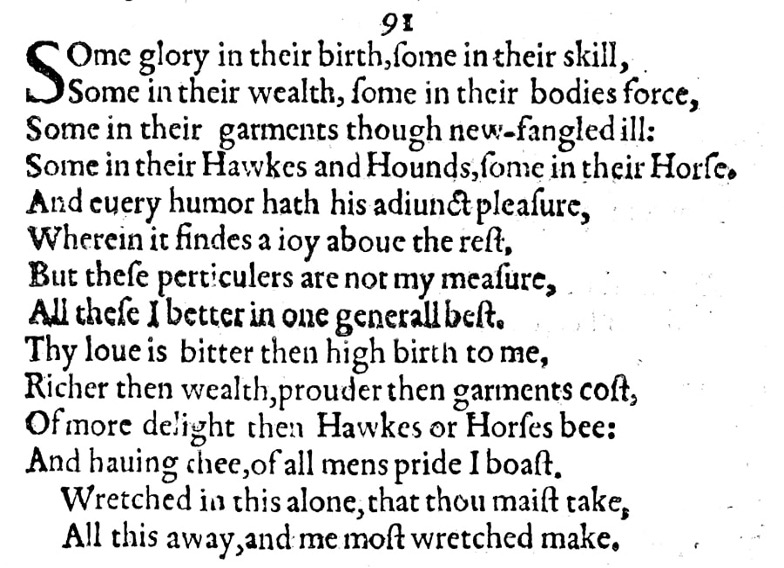
There are only ‘5’ words capitalised in the main corpus of (S.91) ‘Q’ illustrated. “Hawkes, Hounds & Horse” in line four, then again “Hawkes & Horses” in line eleven, letter ‘H’ equates gematrically to ‘8’ and as we have ‘5’ iterations – we are presented with the following sum 5 x 8 = ‘40’.
The ‘content’ of many a Shakespearean sonnet is determined by the sonnet number – not a lot of people know that (S.115) is blessed in line ten with Oxford announcing his love for VVriothesley, with a conventional “I Love You” translating gematrically to 115 and the reason (S.115) was selected to include this endearment. Other classic early examples would be (S.18), (S.19), (S.20), (S.25), (S.26) & (S.33), ‘XIX’ being the day in February 1601 VVriothesley and Essex were convicted of high-treason, ‘20’ VVriothesley’s TRUE date-of-creation, ’25’ the day Essex was beheaded, ’26’ Oxford’s gestation-week birth, and ‘33’ Christs age at crucifixion, while recalling 3 x 3 = ‘IX’.
‘John Dee’ (Oxford’s scholarly friend) elaborated on the Pythagorean dictum “All Is Number” saying “everything has its being in number”, with Oxford construing (S.91) in bipartite form as ‘IX’ & ‘One’ aligning himself and his son with Christ & God, while the sonnet was selected by him because of his deep affection for the phrase: “I AM THAT I AM”, which transposes gematrically to ‘91’.
Our author of “high birth” (S.91 – L ‘IX’) proudly describes his Godly son VVriothesley again in line ‘IX’ (S.33 ‘Q’) with the words “My Sunne one”. If of course these words are read aloud, phonetically they are received as “My son ‘One”, in the same way ‘1740’ may be received as ‘174T’, while a further more nebulous allusion referencing the formation of (The Tudor Trinity) is found amongst this vaulted firmament of Tudor mythology.
Even so my Sunne one early morne did shine.
“My” refers to our great author’s ‘Godly’ son VVriothesley (‘One’) who Christ-like was (literally) born beneath (a mortal) “Venus”, a celestial body we have come to know as the ‘the early morning star’. We also know through research of the rather fabulous late ‘Alexander Waugh’ that ‘Dr John Dee’ was the brain-box behind the complex encryption found on the ‘title page’ and ‘dedication page’ of Aspley’s edition of SHAKE-SPEARES SONNETS (signed Dee). The encryption revealing the precise spot in Westminster Abbey where Oxford is buried, while within the dedication to VVriothesley a further encryption was unravelled by ‘John Rollet’ explaining to all concerned the following:
THESE SONNETS ALL BY EVER THE FORTH T.
Naturally “ever” is a fairly good clue as to who “the forth T” refers to. ‘T’ is ‘Tau’ letter ‘XIX’ of the Greek alphabet (a symbol of Jesus Christ and the crucifixion) therefore, a fourth ‘T’ or 4’T’ multiplied = ‘76’ because the sum 4 x 19 = ‘76’. Then, fast forwarding to (S.76) line ‘7’ we arrive at the point ‘Shakespeare’ considered the dead-centre of his sonnet-sequence, as he perceived his immortal verse composed of 152 sonnets gracefully adorned with a pair of epigrams known as the ‘Bath Sonnets’ (S.153 & 154).
In the year 1133 King Henry 1 awarded the office of ‘Lord Great Chamberlain’ to Aubrey de Vere whose son was created ‘Earl of Oxford’ a title held almost continuously until 1526. Among these many responsibilities (particularly at coronations) apart from dressing the monarch the Earl’s of Oxford held the hereditary privilege of being ‘Everys’ their calling at ceremony to supply drink and water for the monarchs ablutions, a fact referenced at the conclusion of (S.114) also making perfect sense of the central line of his central sonnet 76:
That ‘every’ word doth almost tell my name.
That name being O*X*F*O*R*D because the name:
O = 14, X = 21, F = 6, O = 14, R = 17, D = 4 transposes gematrically to ‘76’.
As I have said, Oxford liked to be associated with the Christian number ‘IX’, but let me show you how the number of his name is entirely linked to the ‘Triple Tau’ a symbol venerated by the Royal Arch Freemasons & Knights Templar. The ‘Triple Tau’ represented by the sum: 3 x 19 = 57, giving the same total as the Oxfordian sum: 17 + 40 = 57. Then, progressing to find the comprehensive number of Oxford’s name gloriously exemplified and registered in the book of the holy-trinity we must add the upside down forth ‘T’ hidden at the centre of the ‘Triple-Tau’ symbol, while not forgetting the fact Shakespeare’s memorial in Westminster Abbey was consecrated in the year ‘1740’.
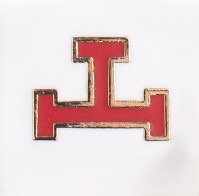
‘John Dee’ in ‘The Hieroglyphic Monad’ of 1567 described ‘the forth T’ the following way:
The Quaternary is concealed within the Ternary. O God! Forgive me if I have sinned against Thee by revealing such a great mystery in my writings which all may read but only the worthy will understand.
“The forth T” is found by negating the ‘roofs’ of the three ‘T’s seen in the ‘Triple Tau’ symbol (illustrated) leaving (dead centre) an inverted (or upside down) forth ‘T’ (referred to by Dee as “The Quaternary”) thus delivering a sum constructed of the ‘Triple Tau’ (57) + the forth ‘T’ (19) = 76 – the number of Oxford’s name.
Little wonder – the figure ‘174T was so critical to whom Oxford considered himself to be, because it also represents his son Henry VVriothesley’s TRUE date-of-creation! His official birthday was 6th October 1573, but his TRUE year-of-birth ‘1574’ is identified by the middle figures found in ‘174T’, figures bookended by the Godly number ‘One’, and ‘T’ for Tau ‘XIX’ together making ‘20’.
The 20th May 1574 VVriothesley’s TRUE date-of-creation is confirmed in (S.20 ‘Q’) line ‘7’, a sonnet which is a ‘physiological’ portrait of him, his name represented by the word “Hews” (capitalised & italicised) a marsupial of the name ‘Henry Wriothesley’ while of some passing interest – I should perhaps also mention the word T*U*D*O*R equates gematrically to ‘74’. (S.20) continues further alluding to Oxford’s mother Elizabeth using his second favourite allusion for her after “Beauty”, the word “Nature”, while not surprisingly this reference to VVriothesley’s glorious birth begins in line ‘IX’.
And for a woman wert thou first created,
Till ‘nature’ as she wrought thee fell a doting.
VVriothesley was at the centre of Oxford’s life, nothing was more important to him than his princely son whom he considered the TRUE first heir to the crown of England – whom he believed should become King Henry ‘IX’.
Thou art the next of blood, and ‘tis thy right. (Venvs & Adonis – L.1184).
Very shortly via (S.114) we shall see how and why in 1603 Oxford wished the newly crowned ‘King James’ dead, while these Royals (Oxford & James) held a common grief appertaining to the 8th letter of the Greek alphabet ‘Theta’, regarded in ancient times as a symbol of death.
The fates decreed when these two infant Princes were both ‘eight’ months old their fathers would come to untimely bloody deaths, ‘James’ father (Lord Darnley) at Kirk ‘o’ field, Edinburgh, and Oxford’s father (Sir Thomas Seymour) at the scaffold on Tower Hill – conversely letter ‘XIX’ of the Greek alphabet ‘Tau’ was regarded in ancient Greece as a symbol of life, which even in the 16th Century still managed to bring good fortune to ‘James’ born in the year 1566 on June ‘XIX’.
Oxford remarks upon his hereditary ceremonial duties in (S.114), integers he saw individually as ‘One’ & ‘14’ in a sonnet written in the year 1603, shortly following the inauguration of ‘King James 1’ where in line twelve our interest is robustly stimulated as he impishly implies, he wouldn’t be too bothered if the drink he supplied to Scottish-James was poisoned!!
At the time of these treacherous ponderances ‘King James’ oldest son ‘Henry Frederick Prince of Wales’ (aged nine) was still a minor, Oxford believing (perhaps-over-ambitiously) in the event of the king’s death his own Princely son – the first Tudor heir – could still succeed the throne, in fact – as related in (S.114 – L ‘IX’) James ‘flatters’ this duo of dying Tudor embers – by greeting VVriothesley with the words “Oh tis the first”, before the sonnet’s conclusion:
12 … And to his palate doth prepare the cup
13 … If it be poisoned, tis the lesser sin.
14 … That my eye loves it and doth first begin.
“Twelve or 14”
The important number here is highlighted in digits – the inferior number not so. Their great significance telling us precisely who our great author was – as the nativity of all illegitimate Tudor princes was defined by two dates (which didn’t necessarily have to be in the same year). Edward de Vere’s official ‘birthday’ was April “twelve” 1550, but his TRUE date-of-creation (his actual date of birth) was July ‘14’ 1548, dates accompanied by some rather interesting data.
Romeo & Juliet meet on July ‘14’ – information relayed in ‘Scene III’ of the play when they meet ‘17’ days prior to Lammas Eve – 31st July. Accompanying these details (when Juliet is actually 13 years of age) bizarrely, the only number mentioned is ‘14’ which pops-up ‘5’ times (alluding to Elizabeth) relating to the fact she gave birth to Oxford when she was ‘14’ and precisely why we are provided with ‘5’ renditions of this number, while following are some further interesting references regarding the number ‘14’.
A Shakespearean sonnet is composed of ‘14’ lines, (S.14) beginning with a glaring astrological allusion which we shall come to, before further revealing with the simplest encoded information that ‘17’s birthday was ‘14’.
On a more negative trajectory, there could be any number of deaths in “Titus Andronicus”, but there just happens to be ‘14’, for with the opprobrium of illegitimacy one dies a little every day. Then, more positively we find L d V & E d V two of the world’s greatest geniuses ‘Leonardo di Vinci’ and ‘Edward de Vere’ stratospherically propelled towards their polymath personas due in part to the ignominy of illegitimacy, a crescendo of scandal needing exorcism – and why we find line ‘14’ of Edmund’s (Sol 1 – ‘Q’) Lear concluding:
“God’s stand up for Bastards”
The guts of (Sol 1) Lear bombard us with ‘5’ renditions of the word “base”, a word translating gematrically the following way:
B = 2, A = 1, S = 18, E = 5 the sum ‘26’.
While unity is found in the further sum: “twelve + 14 = 26” figures representing our author’s extraordinary, miraculous, Royal nativity. Happily, in the context of modern literature – t’was summer when Oxford’s ‘premature-birth’ at gestation week ‘26’ took place, a delivery verified by a clutch of postnatal words found in (S.26), where along with ‘four’ renditions of the word “show” the words “bare” and “all naked” also appear – then, as if straight out of the midwifes almanack, miraculously we find in (S.26 – L 14) the heavy crown of genius emerging – exemplified by the nascent words:
“Show-my-head”.
In Shakespeare’s play “King John” facts regarding Oxford’s Royal nativity are confirmed by the bastard character “Philip” (the illegitimate son of a very famous King) ‘Coeur de Leon’, who rather like Oxford (was the illegitimate son of a very famous Queen) ‘Elizabeth’.
In “King John” Philip’s legal brother “Robert Faulconbridge” informs us in (Line 114 ‘Q’) his “Bastard” brother came into the world:
Full ‘14’ weeks before the course of time. (at gestation week 26)
Autobiographical detail compounded with an ‘Ox’ allusion spoken by the King.
In sooth, good friend, your father might have kept this calf, bred from his cow, from all the world.
As fortune would have it, the infant Oxford was placed like a cuckoo’s egg in a reed-warbler’s nest – his Royal DNA having absolutely nothing to do with the de Vere family at all – a “changeling” situation bought about by intelligence received by Sir William Cecil of a bigamous marriage Oxford’s nominal father Earl-John had with ‘Joan Jockey’. This information gave Cecil the opportunity to help his new found friend princess Elizabeth in her desperate time of need, while causing some considerable upheaval in Earl-John’s life, because with the banns already twice read regarding the day he supposedly was marrying ‘Dorothy Fosser’ (importantly eighteen days after Oxford’s birth) with a little bit of ‘persuasion’ from the authorities ‘that very same day’ he ended up marrying an entirely different woman ‘Margery Golding’.
Margery (who gets a mention in “The Merchant of Venice”) was the sister of tutor & translator ‘Arthur Golding’ who later following Earl-John’s death (with Oxford’s help) at Cecil House in London translated “Ovid’s Metamorphoses” into English, a work first published in 1567 when Oxford was age ‘XIX’.
In an interesting note (politics & religion aside) we discover the nick-name of the character ‘Sir John Oldcastle’ from “Famous Victories” was “Jockey”(this play being a predecessor to the Prince Hal trilogy), while “Joan Jockey” was the infamous woman the Jovian ‘Earl-John’ 16th Earl of Oxford bigamously married. Was this de Vere link then the reason (Jockey) ‘Sir John Oldcastle’ was nobbled by the censors, beginning a new life as ‘Sir John Falstaff’ a ‘changeling’ situation thereby negating unwanted historical truths relating to the de Vere’s.
At the time of Oxford’s infancy – advantageously for the arts, and luvviness existing in the world – the propitious outcome (for humanity & the arts) of these many nefarious goings on meant he would spend the most important (life determining) first five years of his life ensconced within the de Vere family stronghold of ‘Hedingham-Castle’ Essex, which significantly from the end of the fifteenth century had its very own resident troupe of players.
Then, moving forward somewhat (from thespian infant to thespian adult ‘deceased’) Oxford’s Royalty gets a massive plug in the very last paragraph of “Hamlet”, a play where “there shows much amiss!”
Fortinbras … “Let four captains bear Hamlet like a soldier to the stage, for he was likely, had he been put on, to have proved most Royal”.
‘This Royalty’ heavily elaborated upon in “Venus & Adonis” is alluded to by the Tudor colours ‘red & white’, which with the colour ‘purple’ are mentioned multiple times. Oxford was Royal because his mother Elizabeth was Royal, but these parents were eclipsed in the Royalty stakes by their Princely son ‘Henry VVriothesley’ who in terms of DNA was (the ultimate “Happy”) as both his parents oozed purple-blood, a point emphasised in “Venus and Adonis”.
‘Tis true, ‘tis true! Thus was Adonis slain –
He ran upon the “boar” with his sharp spear,
Who did not whet his teeth at him again,
But by a kiss thought to persuade him there,
And, nuzzling in his flank, the loving swine
Sheathed unaware the tusk in his soft groin. (Stanza 186)
By this, the boy that by her side lay killed
Was melted like a vapour from her sight,
And in his blood that on the ground lay spilled,
A purple flower sprung up, chequ’red with white,
Resembling well his pale cheeks and the blood
Which in round drops upon the whiteness stood. (Stanza 195)
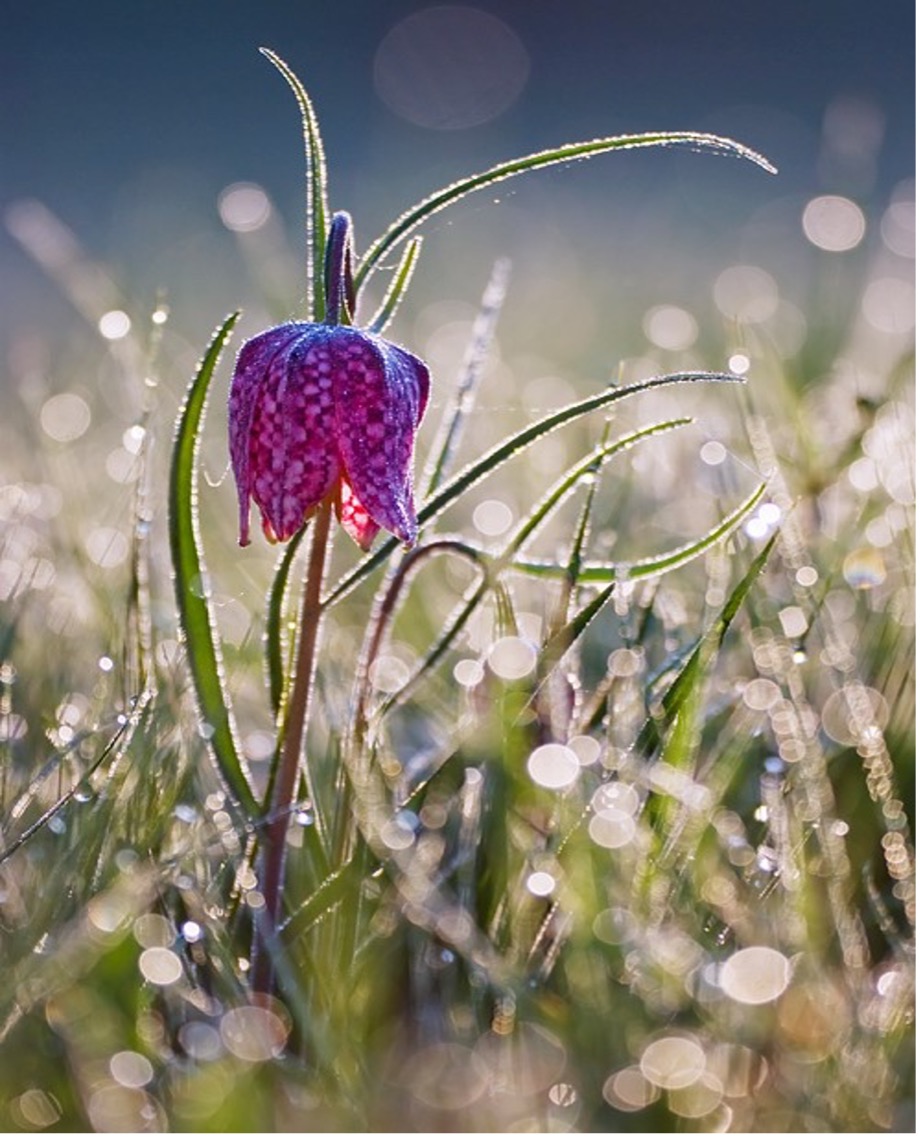
In stanza 195 (of 199) we find the purple-haze of Henry VVriothesley’s Royal creation alluded to with a reference to the ‘Meleagris Lilly’ (commonly known as the fritillary) a flower Oxford is seen holding in the front-piece engraving of ‘John Gerards’ 1597 book on the history of plants ‘The Herball’. This illustration comes with a reflection of Oxford’s favourite poet ‘Ovid’, who tells the tragedy of Narcissus and Echo, a story warning of self-loving perils. Of a beautiful boy who fell in love with his own image – upon whose death – no body was found for the bier – only a flower with a trumpet of gold and pale white petals.
This tale alludes to Oxford’s own death in 1604 (along with any hope of legitimacy to be found in the annals of literature) an eventuality he tried so very hard to mitigate, his fate foreseen in (S.72) in a hymn of incest.
My name be buried where my body is
And live no more to shame nor me, nor you,
For I am shamed by that which I bring forth,
And so should you, to love things nothing worth.
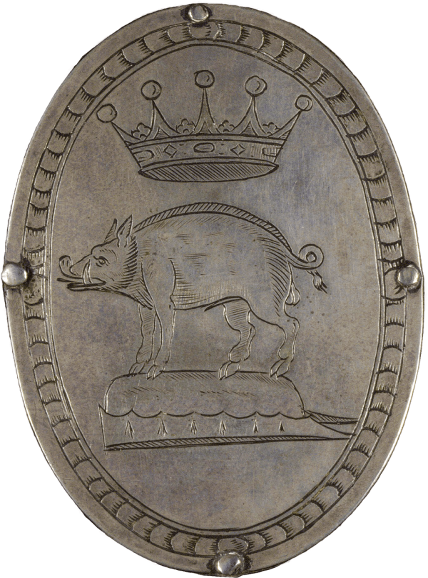
Oxford persistently seeking the surreptitious to explain the vicissitudes of his complex life – mentions the boar in “Venus & Adonis” exactly ‘17’ times – while we see on the cover of his Geneva bible an oval silver boss engraved with the de Vere family crest – a blue boar surmounted with an Earls coronet embellished with five pearls.
(S.144) pays homage to the surreptitious – with content perhaps more ingenious than the boar, while I must elaborate on the time VVriothesley found himself deposited (in good faith) like a “gage” (a prized possession) at the recently fortified Windsor Castle with its new ordnance of ten cannon requested by the Queen – where to the displeasure of his father he was a guest of his mother’s.
This exclusively Royal narrative is ‘foretold’ in “Lucrece” where line ‘144’ becomes a manicule identifying VVriothesley as the chief male protagonist of (S.144), while remembering (S.127 – 152) are the dark-lady series of sonnets represented here by “a woman coloured ill”, further identified in the penultimate line by the word “bad” which translates gematrically to ‘7’. Line ‘144’ of “The Rape of Lucrece” therefore unequivocally identifies Henry VVriothesley as the “better angel” gracing sonnet 144:
That one for all or all for one we gage. (“Lucrece” Line 144.)
“One for all, all for one” was VVriothesley’s motto, with the final word “gage” translating gematrically to ‘20’, his TRUE-day-of-creation: 20th May 1574.
VVriothesley’s attraction to his powerful mother is of course understandable and while the empathy and love expressed by Oxford for his son has been described as the greatest love in literature, it is hardly surprising Elizabeth’s youngest prince was tempted by the glory, glamour and trappings of wealth that came along with being in the courtly company of his mother the Queen. From Oxford’s different perspective he thought the situation ‘wrong’ or ‘unacceptable’ (particularly when considering the possibilities of incest) or put more simply, he regarded the situation as ‘gross’, which is of course ‘144’.
Following is (S.144) as it appears in P.P (The Passionate Pilgrim) first published 1598 (when Oxford was still alive), while come the second version (following below immediately after the first) he felt braver altering, as arranged it would not to be published until he was deceased for five years – a request which came to fruition – as eventually it was published on the 20th May 1609 in celebration of Henry VVriothesley’s TRUE date-of-creation.
Sonnet 144. (from P.P) 1598.
(In Vita).
Two loves I have, of comfort and despair,
That like two spirits do suggest me still:
My better angel is a man (right fair),
My worser spirit a woman (coloured ill).
To win me soon to hell, my female evil
Tempteth my better angel from my side,
And would corrupt my saint to be a devil,
Wooing his purity with her faire pride;
And whether that my angel be turned fiend
Suspect I may (yet not directly tell):
For being both to me, both to each, friend,
I guess one angel in another’s hell.
The truth I shall not know, but live in doubt,
Till my bad angel fire my good ‘One’ out.
Sonnet 144. (‘Quarto’) 1609
(In Morte).
Two loves I have of comfort and despaire,
Which like two spirits doe sugiest me still,
The better angell is a man right faire,
The worser spirit a woman collour’d ill.
To win me soone to hell my female evill,
Tempteth my better angel from my sight,
And would corrupt my saint to be a divel,
Wooing his purity with her foule pride;
And whether that my angel be turn’d finde
Suspect I may, yet not directly tell,
But being both from me both to each friend, I guess one angel in another’s hel.
Yet this shal I ne’er know, but live in doubt,
Till my bad angel fire my good ‘One’ out.
During this golden period of English literature, language and spelling had not been completely standardised as it is today. In the ‘Quarto’ above we see various spellings: Angell & angel, and similarly Hell & hel, while “fiend” becomes “finde” and there is only one L in shal etc.
The extremely important point I need to make though, regards the word “do” which in that time-frame more often was typeset as “doe” rather than “do”. In the twenty poems of P.P ‘Q’ it appears five times written as “doe” and only twice as “do”, where in (S.144 – ‘Q’) we find rather frustratingly the compositor had failed to follow manuscript copy, and I have had to add the absent ‘e’ to “doe” in line two, or all the components of “The Oxford/Shakespeare brand 1740” (as intended by Oxford) would be incomplete.
A comparison of the ‘living’ and ‘dead’ published versions of (S.144) show beyond reasonable doubt they were written by a man associated with ‘Oxfordian-numerology’ represented by the numbers “1740”, something easily seen by the disparity of the two different versions – the meeker P.P ‘living version’ and the more scolding ‘dead version’, in which Oxford (more daringly) touches upon his mother’s “foule pride”. Significantly, lines 3, 4, 5 & 6 in the living P.P version begin with the letters M, M, T, T, while in ‘Q’ clearly the four ‘T’s in the same locus represent “40” which together with the preceding “doe sugiest me still” (17 letters) amount to ‘174T’ or ‘1740’.
Shakespeare’s famous metaphysical poem “The Phoenix and the Turtle” appears in the host work “Love’s Martyr” strategically placed on page 170 (that’s ‘17 zero’) as he saw it, the poem covering three pages 170, 171 & 172. And if you would like to understand the poems TRUE meaning I am responsible for a work fully analysing it – accessible via the internet – entitled:
“With the Breath Thou Giv’st and Tak’st”.
Expressing ‘Sacred 3’, beginning on Page 26 my work explains how the poem is constructed encompassing ‘3’ renditions of “The Oxford/Shakespeare brand 1740” and is easily understandable as it is colour-coded for this very purpose.
This immensely complex and mathematical poem is immediately succeeded on Page 173 by a funeral-ode for “The Phoenix and the Turtle” hypothetically anticipating the immolation of the Phoenix (Elizabeth), so some “glorious issue” (H.VV) could “spring forth” from “yonder flame”, it continues:
10 … Let me stand numb’d with wonder, never came
11 … So strong amazement on astonish’d eye
12 … As this, this measureless pure Raritie.
For “Raritie” read ‘VVriothesley’ – precisely the implication intended by Oxford where allusion is found amongst other less mythical, more autobiographical stuff written in verse and entitled “A Narration …” poetry deliberately constructed of ‘26’ lines referencing Oxford’s Royal nativity.
Significantly, the first letter of line ‘14’ is a fourth ‘T’ mathematically identifying ‘OXFORD’ whose TRUE-date-of-creation was ‘14’, so this particular line of language, grandiloquent but TRUE, must be telling us something important:
14 … The soul of Heaven’s labour’d Quintessence.
While some will argue these words are not Shakespeare’s, the cockles of my heart know differently – and more correctly, arguably (autobiographically) they are the most important words across the entire Shakespeare cannon.
Gravitas pervades line ‘14’ of this ‘26’ lined poem – and the importance of its meaning cannot be stressed enough – as we receive confirmation OXFORD considered himself the guardian “soul” of five illegitimate princes “quinte” (all male) divinely ordained in “Heaven” but “labour’d” on Earth by the (Queen) a fact confirmed because the word “Queene” (as he spells it) is a marsupial of the word “Quintessence”.
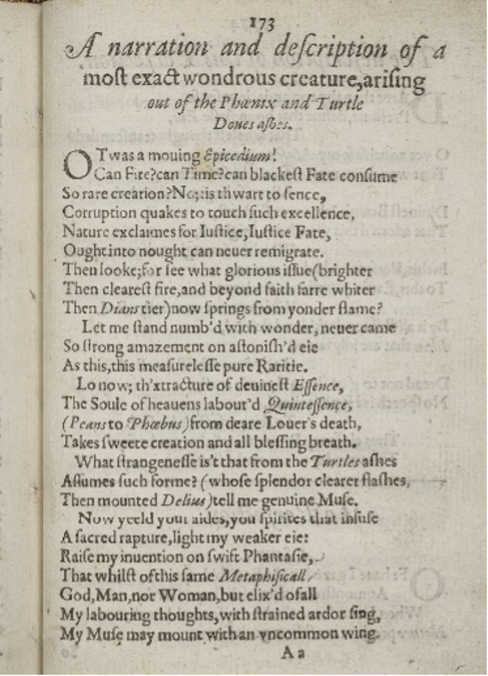
By kindest permission of “The Folger Shakespearean Library”. Oxford’s poem empathising with the sum “twelve” + ‘14’ = 26.
“A Narration” (illustrated) provides us (L 6) with the words “can never remigrate” composed of ‘17’ letters, while ‘40’ is represented by four ’T’s which follow immediately, as lines 7, 8 & 9, all begin with the letter ‘T’, with the fourth ‘T’ (as we have seen) beginning line ‘14’ the number representing Oxford’s TRUE date-of-creation.
‘This important line’ informs us Oxford considered himself the guardian-soul of “Heavens labour’d Quintessence” (five princes born to the virgin Queen).
“The Oxford/Shakespeare Brand 1740” surfaces in (S.111) Oxford finding himself both subpoena and subdued by the brand “Shakespeare”, having reluctantly agreed ‘till parted by death’ to a £1000.00 per annum stipend from the Queen (revenue without conditions) a “brand” testified to by line ‘5’ of the sonnet – a line beginning with a forth ‘T’.
Thence comes it that my name receives a brand.
From Brand to Band
It has been said “Sir Francis Walsingham” fathered “Francis Bacon” who declared his band of brothers the lost children “enfants perdus”, with chronological issue of the two Princes ‘Oxford’ & ‘Bacon’ followed by ‘Robert Devereux’ (Essex) ‘Arthur Dudley’ and lastly ‘Henry VVriothesley’.
This father/son Christian namesake-affiliation – is also seen in the name ‘Robert Devereux’ who’s paternity was graced by ‘Robert Dudley’ who fathered two of the Queen’s issue (Robert & Arthur) while ‘Henry VVriothesley’ (fathered by Oxford) was named after his grandfather ‘King Henry VIII’.
(S.97) Speaks of widowed wombs immediately before lines ‘IX’ & 10.
“But this abundant issue seemed to me – The hope of orphans and un-fathered fruit”.
These two lines sing a solemn song of autobiography – for this “abundant issue” of princes are rather sadly not only motherless (as their true mother is a virgin Queen) but also orphans, as invariably they don’t have fathers either (they can readily speak of). We should also consider the fact Oxford’s own father was put to death for acts considered treasonous, while VVriothesley couldn’t possibly spill the beans letting it be known he was sired by Oxford. “The hope of orphans” therefore was absolutely futile because as identified by Bacon they were just “enfants perdus”, illegal (lost children) orphans with no hope of redemption!
Oxford’s own executed father ‘Lord admiral Sir Thomas Seymour’ often spoken of as a scoundrel – hitherto has received a very bad press, and although I don’t doubt a lot of this vilification is completely justified, I always like to see the good in people. We know he wrote verse, and was said to have had a charismatic way of speaking, a seductive way with language, and there is no doubt in my mind, her grace princess Elizabeth found herself emotional challenged not only by his lyrically patter but the masculinity of his voice and the outrageous physicality of what for him (before she conceived) was effectively a sustained period of foreplay – what feminists might call grooming! The fact that amongst his many deficiencies Oxford’s father was a great wit – should come as no surprise, while following his execution (which allegedly caused the princess a nervous-breakdown) she is said to have remarked:
“This day died a man with much wit and very little judgement”.
As already stated in Lear the illegitimate ‘Ed-mund’ is a mouth-piece for the illegitimate ‘Edward’ (Oxford) whose father’s stately pile (in reality) was ‘Sudeley Castle’ in Gloucestershire, and precisely why Edmund’s father is called “Gloucester”, who enunciates on the very first page of Lear (remembering alliteratively speaking Seymour is very saucy) the following:
Gloucester … Though this knave came something ‘saucily’ to the world before he was sent for, yet was his mother faire, there was good sport at his making.
In Lear Oxford seeks revenge on his TRUE father through Gloucester’s blinding (actually a metaphor for castration) while ‘Edgar’ (Edmund’s legitimate brother) speaks mirthlessly of his brother’s conception:
“The dark and vicious place where thee he got cost him his eyes”.
A gloomy revelation expanded upon with a bloody allusion to castration:
“My father with his bleeding rings – their precious stones new lost”.
In respect of his Royal nativity Oxford considered a dozen dull – while ‘14’ had magical or messianic qualities, represented in his heart by a place where “Truth and Beauty” (Oxford & Elizabeth) “shall together thrive” precisely what (S.14) says, its opening gambit celebrating his TRUE date-of-creation where a little-song (celestially conceived) justly opens with an astrological allusion:
Not from the star do I my judgement pluck
And yet me thinks I have Astronomy.
Edward de Vere knowing humanity dim-witted – provides the very simplest of mathematics in (S.14 ‘Q’) explaining that ‘17’s TRUE date-of-creation is ‘14’. He does this by singling-out four capital letters in the main corpus of the sonnet. In line two “Astronomy” has a capital ‘A’, in line seven “Princes” has a capital ‘P’, then as A = 1, and P = 15 in subtracting one from toother – we get ‘14’.
In the last line “Truths” has a capital ‘T’ and “Beauties” has a capital ‘B’ and as ‘T’ = 19, and ‘B’ = 2 subtracting one from the other we get ‘17’. So, embracing simple mathematics – we learn ‘17’s TRUE date-of-creation is ‘14’.
“Moonshines”
“Moonshine” & ‘moonlight’ are not the same thing. Moonlight is reflective light from the sun (often silver in Oxford’s eyes) while “moonshine” (frequently fantastical) generally represents the illicit – a place of fantasies where fairy-dust prevails and fairies dance in the dead of night under canopies of polka-dot mushrooms, and why found in a MSND are multiple references to it.
An illuminating way of describing how “moonshine” might exist as fantasy, would be a Queen who had bought five children into the world – but nevertheless was determined to be known as the “Virgin Queen”.
On the other hand Oxford who knew her intimately, in Lear (Sol.1) beginning in (line ‘7’ Q) describes her indecorous conduct more realistically as:
The lusty stealth of ‘nature’.
In L.L.L. “Dull” asks what is “Diktynna”, to which “Sir Nathaniel” answers:
A title to Phoebe, to Luna, to the Moon.
“Phoebe” simply means ‘bright’ or ‘light’, her connection to the moon a symbol of her reputation for radiating both enlightenment and intelligence to mortal and Godly spheres. Her consort was her brother ‘Coeus’ with whom she incestuously conceived two daughters Leto & Asteria, it is therefore not too hard to see why Oxford associated Elizabeth with Phoebe and moonshine.
There are two things an author’s heart will inevitably divulge in his writings, anguish and love, and if one of your earliest sexual experience takes place with your mother (the Queen) it is highly unlikely to slip easily from memory!
‘Content’ in the very first paragraph of MSND informs us it was written prior to Elizabeth’s death – while not forgetting that “happy” often implies ‘Royalty’.
Theseus … “Now fair Hippolyta, our nuptial hour draws on apace; four happy days bring in another moon: but ‘O’, methinks, how slow this old moon wanes! She lingers my desires, like a step-dame or a dowager, long withering out a young man’s revenue”.
“O” had a long standing gripe with the state – his penury (as he perceived it) beginning when his nominal father ‘Earl-John’ suddenly, mysterious died (possibly murdered) and as he was still a minor of ‘14’ years was stripped of his inheritance – becoming a ward to the Queen. Elizabeth having been forced to sign the death warrant of her own son (and possible lover) ‘Essex’ found herself wracked by a terrible psychological conflagration, termed “Fever’s end” in line ‘7’ of the ‘Phoenix-poem’, a morose terminal condition she suffered following the tragic death of Essex. Then as she insisted she was wedded to her country of England (at a time the Lord Chancellor had effectively taken control of its affairs). Did Oxford then consider this metaphorical union between Queen and country also deceased – and was this the very reason he called her dowager? Slightly earlier, in her mid-sixties (even before the demise of Essex) Elizabeth had begun to struggle a bit, at a time Oxford still found it acceptable (for the sake of theatre) to take the piss, of course, when her waning finally, terminally ceased – he was absolutely devastated.
In a letter of great beauty he wrote to ‘Robert Cecil’ his brother-in-law, dated April 25th 1603 he described his personnel loss “above all the rest” in a heartfelt missive enriched with many a ‘tempestuous’ allusion (lacking no sympathy for posterity) the letter mournfully signed:
“Your unfortunate brother-in-law”.
Sir Robert Cecil.
I cannot but find a great grief in myself to remember the mistress which we have lost,
Under whom both you and myself from our greenest years have been in a manner
Bought up; and although it has pleased God after an earthly kingdom to take her up
Into a more permanent and heavenly state, wherein I do not doubt but she is crowned with glory and to give us a prince wise, learned, and enriched with all virtues, yet the Long-time which we spent in her service, we cannot look for so much left of our days as to bestow upon another, neither the long acquaintance and kind familiarities wherewith she did use us, we are not ever to expect from another prince, as denied by the infirmity of age and common course of reason.
In this common shipwreck, mine is above all the rest, who least regarded, though
Often comforted of all her followers, she hath left me to try my fortune among the
Alterations of time and chance, either without sail, whereby to take advantage of any
Prosperous gale, or with anchor to ride till the storm be overpast. There is nothing therefor left to my comfort but the excellent virtues and deep wisdom wherewith God hath endued our new Master and Sovereign Lord, who doth come amongst us not as a stranger but as a natural prince, succeeding by right of blood and inheritance, not as a conqueror, but as the true shepherd of Christ’s flock to cherish and comfort them.
Your assured friend and unfortunate brother-in-law.
E. Oxenford.
Beautiful as this letter truly is – the colloquial contrivances of my mind provide esoteric knowledge as to etymology of the word “quaint”, because if you have ‘known’ a woman as Oxford knew his mother – you have been “acquainted” with her, this language of sophisticated deception confirming Oxford’s use by his mother for ‘incestuous’ pleasures:
Neither the long acquaintance and kind familiarities wherewith she did use us.
If he is as I suggest alluding to INCEST, the last word in the above line “us” refers to his brotherhood of illegitimate consanguineous princes referencing familia-behaviour, that “we are not ever to expect from another prince” (although the history of European Royalty would prove differently).
His letter indicates future service to the monarchy may be “denied by the infirmity of age and common course of reason” thereby mentioning his well-known disability (lameness) in a general sense, a disability originally sustained following serious injury to his leg after an accident in a Venetian Galley. This lameness is mentioned twice in (S.37) & (S.89) an affliction getting further coverage in two letters written to Robert Cecil dated 25th March 1595 and 25th April 1603.
When your Lordship shall have best time and leisure if I may know it, I will attend your Lordship as well as a ‘lame’ man may at your house.
If it be so, what order is resolved on amongst you, either for the attending or meeting of his Majesty for, by reason of ‘mine infirmity’, I cannot come among you so often as I wish, and by reason my house is not so near that at every occasion I can be present, as were fit.
“Lag of a Brother”
Critically important “LAG” translates gematrically to ‘Tau’ the Christian number ‘XIX’, ‘Tau’ being a symbol of the Royal Arch Freemasons & Knights Templar – orders our great author was closely associated with.
L = 11, A = 1, G = 7 totalling ‘XIX’.
“The Essex/Christ Allusion” (of which there are three iterations) arose in Oxford’s omniscient mind because of very simple parallels existing in these two martyr’s lives – observations born-out in the following statement:
Both Essex and Christ were born of Virgins
And both put to death for their beliefs.
“Lag of a brother” – the ‘first’ of these allusions is found in Edmund’s (Sol 1) Lear stating quite plainly our author had been “deprived” of a brother – adeptly identified in the ‘second’ allusion – represented by sonnet ‘XIX’ in which ‘Robert Devereux’s’ 2nd Earldom is cited twice, ‘Dev for Devereux’ appearing in the first and second lines.
Outrage is apparent though – as this short tribute to his consanguineous brother ‘Essex’ stirs up bad-blood with his mother (the Phoenix) as words of a treasonous nature drip from the end of our author’s fingertips (crimes of erudition he considered would be annulled by death).
Devouring time, blunt thou thy Lions paws
And make the earth devour her own sweet brood,
Pluck the ‘keene teeth’ from the fierce tigers jaws
And burn the long live Phoenix in her blood.
Oxford regarded heroic “keene-teeth” as enamel belonging to an Elizabethan Prince (Essex), with ‘E’ for Elizabeth occurring ‘5’ times underlining the fact the brother he was “Lag” of was a prince – as 5 x 5 = 25, bringing us reluctantly to Essex’s last day on Earth – 25th Feb. 1601. Naturally (S.25) is where we find Oxford biding his brother farewell, it’s concluding couplet confirming the notion, however many sons a mother has, with the first arrival an immovable and special bond is sealed – in this case with our great court-poet – who held a secure position other courtiers were fiercely jealous of, while Essex “The painful warrior” (a great princes favourite) became the sacrificial pawn.
The painful warrior famousèd for might
After a thousand victories once foiled
Is from the book of honour razèd quite
And all the rest forgot for which he toiled.
Then Happy I, that love and am beloved
Where I may not remove nor be removed.
Finally – gloriously hidden in plain view (from those wishing not to see it) we alight upon the ‘third’ iteration of “The Essex/Christ Allusion”, represented by line ‘XIX’ of Shakespeare’s allegorical avian-poem about the mythical ‘Phoenix’ (Elizabeth) and the ‘Turtle-dove’ (our author) a memorial written for ‘Essex’ who in the afterlife (in the guise of a swan) became a poetic follower of Apollo.
“With the breath thou giv’st and tak’st”
Elizabeth gave breath to Essex at birth and when she signed his
death-warrant and he was executed – she took his breath away.
*Philip Cooper fecit © 18th April 2025*.
High Priest: Companion Captain of the Host, are you a Royal Arch Mason?
Captain: I am that I am.
High Priest: How shall I know you to be a Royal Arch Mason?
Captain; By Three Times Three. (T,T,T).
Reference (S.121 & S.133) & post-script to Oxford’s letter to Burghley dated (30 Oct 1584).
Sign up for news updates
Join our mailing list to be notified of news updates from Call-me-naive.com